Every cup of tea carries more than aroma and warmth. It carries the movement of plants, gestures of hospitality, classical texts, monastic habits, courtly refinements, and trade routes that crossed continents. Few drinks condense botany, ritual, and historical power so intensely.
Golden rule of tea history: not everything begins with documented fact. Part of its origin lives in the realm of legend, and another part gradually emerges through increasingly clear cultural, agricultural, and commercial records.
The Legendary Origin: Shennong and the Memory of the Beginning
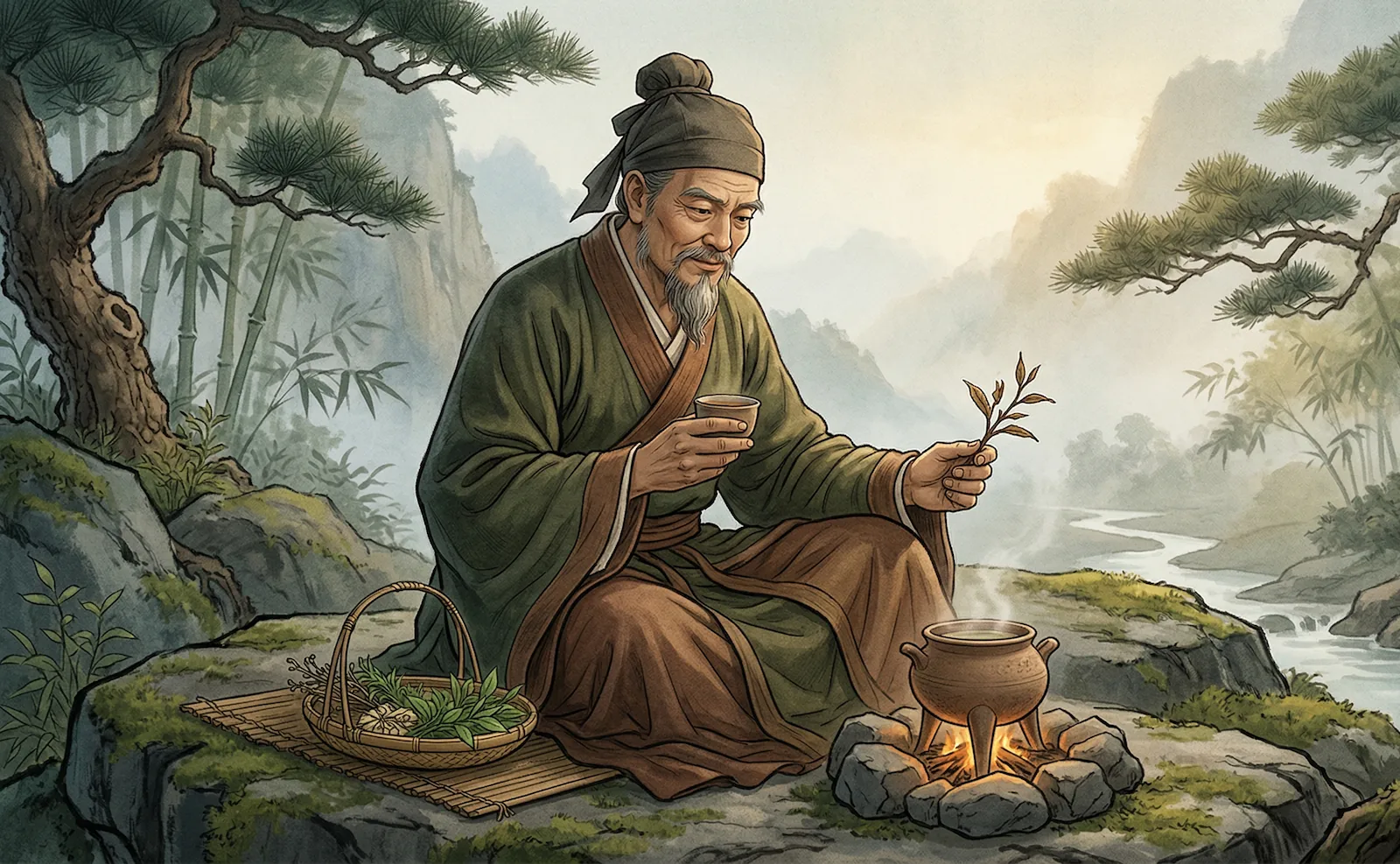
The most famous story about the discovery of tea belongs to the mythical emperor Shennong. According to tradition, leaves accidentally fell into boiling water, creating a new, clean, invigorating drink. It is a legendary story, not a proven fact — but its symbolic power is immense, because it presents tea as a meeting point between nature, observation, and care.
Even when legend is separated from history, something remains: in ancient China, tea was early associated with medicine, vitality, and daily life. Before becoming a fully developed social refinement, it already held an important place in material and food culture.
Tang, Lu Yu, and the Moment Tea Becomes Culture
It was during the Tang dynasty that tea gained another scale. It stopped being only a useful substance or local habit and began to occupy an explicit place in Chinese cultural life. In this context, Lu Yu wrote the Cha Jing, known in English as The Classic of Tea, often treated as the first great book on tea.
This moment is decisive because it transforms tea into language. Water, utensils, preparation, quality, and sensitivity stop being merely practical matters and begin to form a written tradition. From that point on, tea is no longer only consumed: it is also thought about.
From China to Japan: Monks, Green Powder, and Discipline
Japan did not receive tea merely as a commodity, but as a cultural practice. At different moments, Buddhist monks helped carry the habit of drinking tea, and later certain powdered preparation methods gained central importance. Eisai, in the 12th century, is traditionally remembered as a decisive figure in introducing and defending this custom in Japan.
- 1Early centuries: tea reaches Japan through channels linked to cultural and religious exchange with China.
- 212th century: Eisai associates tea with monastic discipline and the care of body and spirit.
- 3Later periods: the act of preparing and serving tea takes on ritual, aesthetic, and philosophical form.
Chanoyu and the Refinement of Sen no Rikyū
Over the centuries, drinking tea in Japan stopped being mere consumption and became an art of presence. In the 16th century, Sen no Rikyū gave decisive shape to the way of tea that would become a lasting reference. Rather than exuberance, he consecrated an aesthetic of restraint, attention, hospitality, and silent depth.
At this point, tea ceases to be only a drink and becomes an environment: room, utensil, gesture, silence, season, and encounter. The tea ceremony, or chanoyu, is born as a cultural practice of great density and remains one of the most refined expressions in the history of tea.
Arrival in the West: Curiosity, Luxury, and Prestige
In Europe, tea first arrived as an expensive novelty, exotic and strongly linked to maritime trade. It was not yet a popular drink: it was a luxury. It entered through mercantile circuits, elite households, and courtly environments until it began to become a marker of social distinction.

Catherine of Braganza did not “invent” tea in England, but her marriage to Charles II in 1662 helped make it elegant and desirable at the English court, accelerating its association with social prestige.
Decades later, another layer would be added: afternoon tea. This custom is associated with Anna, seventh Duchess of Bedford, around 1840, when the interval between lunch and dinner began to be filled with tea, breads, sweets, and sociability. It is important to separate the two stories: Catherine helped ennoble the drink; Bedford established a specific social ritual around it.

Empire, Espionage, and the Turning Point of the 19th Century
If the first phase of tea history was marked by origin, cultivation, and ritual, the next was marked by empire. In the 19th century, Robert Fortune was sent by the East India Company to China and managed to obtain plants, technical knowledge, and processing information in an operation that became famous precisely because of its clandestine nature.
This episode helped break China’s absolute centrality in production for the British market and encouraged the expansion of tea cultivation in territories such as India. From then on, the global history of tea also becomes a history of biopiracy, botanical transfer, and economic reordering.
Tea as a Global System
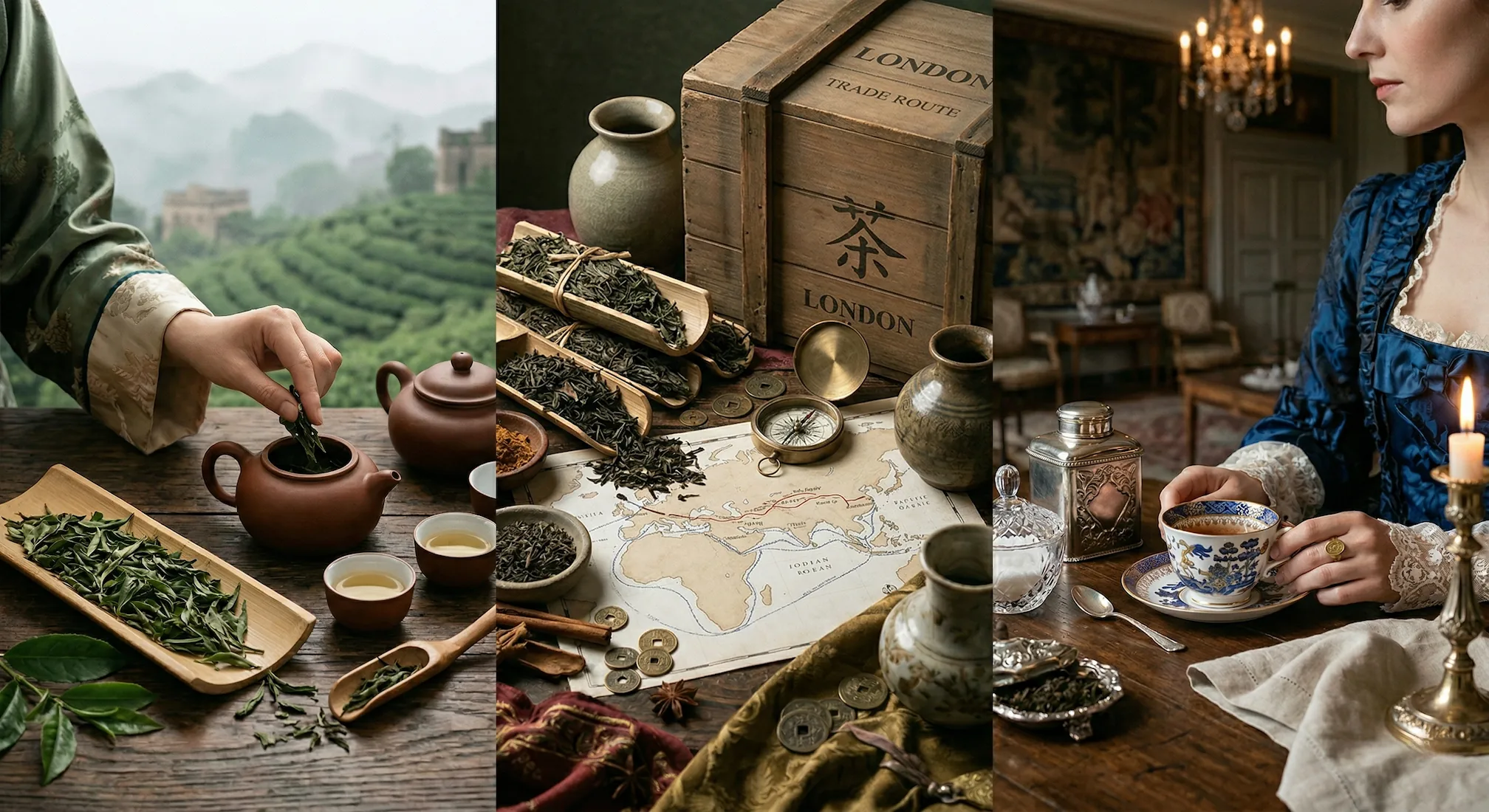
By the 19th century, tea was already moving on a planetary scale. Clippers transported cargoes quickly, London became a center of trade and auction, and the drink began linking farms, factories, ports, exchanges, emporiums, and household tables within a single circuit. What begins as leaf and water turns into a historical network.
- 11. Cultivation: tea is born in specific regions, with their own climate, altitude, and labor.
- 22. Processing: the leaf gains style, identity, and stability for travel.
- 33. Circulation: ships, trading companies, and maritime routes connect production and consumption.
- 44. Consumption: each society reinvents tea in its own way — as medicine, ritual, courtly symbol, daily pause, or ceremony.
Perhaps that is what makes tea so historically fascinating. It was never just a drink. It was medicine, discipline, etiquette, commodity, art, empire, memory, and affection. By the time a cup reaches your hands today, it has already crossed far more than distance: it has crossed centuries.